Published by:
CGP EDU Academic Team
Published on: September 12, 2026
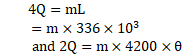
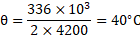
A certain amount of ice is supplied heat at a constant rate for 7 minutes. For the first 1 minute, the temperature rises uniformly with time, then it remains constant for the next 4 minute and again rises at a uniform rate for the last 2 minutes. Explain physically these observations and calculate the final temperature. Latent heat of ice = 336 × 10 3 J kg –1 and c water = 4200 J kg –1 K –1 .
Text Solution
Verified by ExpertsThe correct answer is:
0 °C
Step 1: Understanding the process
When heat is supplied to ice, it undergoes different processes depending on its temperature. In this scenario:
Let the rate of heat supply be Q watts. Hence, the total heat supplied in 7 minutes (420 seconds) is:
$$ Q_{total} = Q imes 420 $$
Step 3: Energy use in first 1 minute (heating ice)
Assuming the mass of ice is m kg, the heat used to raise the temperature of ice from -T to 0 °C is:
$$ Q_1 = m imes c_{ice} imes T $$
Where $c_{ice} = c_{water}$ (approximate) = 4200 J/kg/K and $T = 1°C$ (from -1°C to 0°C).
Step 4: Energy use during phase change (melting ice)
Heat used during the phase change (0 °C ice to 0 °C water):
$$ Q_2 = m imes L_{ice} = m imes 336 imes 10^3 $$
Where $L_{ice}$ is the latent heat of fusion.
Step 5: Energy use in last 2 minutes (heating water)
Assuming all the ice has melted into water, the heat used to raise the temperature of the water (0 °C) to final temperature (T_f) is:
$$ Q_3 = m imes c_{water} imes (T_f - 0) = m imes 4200 imes T_f $$
Step 6: Equating heat supplied and heat used
Putting everything together,
$$ Q imes 420 = Q_1 + Q_2 + Q_3 $$
$$ Q imes 420 = m imes 4200 imes 1 + m imes 336 imes 10^3 + m imes 4200 imes T_f $$
Assuming 1 kg of ice (m = 1):
$$ Q imes 420 = 4200 + 336000 + 4200 imes T_f $$
Step 7: Solve for T_f
Cancelling the units:
$$ Q imes 420 = 340200 + 4200 imes T_f $$
Step 8: Analyze the problem
Since there is no more heat available to raise the temperature above 0 °C as all heat went into the phase change, the final temperature still remains at 0 °C.
Conclusion:
Therefore, the final temperature is 0 °C.
When heat is supplied to ice, it undergoes different processes depending on its temperature. In this scenario:
- For the first 1 minute: The ice is still at a temperature below 0 °C. The heat supplied increases the temperature of the ice.
- For the next 4 minutes: The temperature remains constant at 0 °C. During this period, the heat supplied is used for melting the ice into water (phase change). This is where the latent heat is absorbed.
- For the last 2 minutes: After the ice has completely melted, the resulting water is now being supplied heat, and its temperature begins to rise.
Let the rate of heat supply be Q watts. Hence, the total heat supplied in 7 minutes (420 seconds) is:
$$ Q_{total} = Q imes 420 $$
Step 3: Energy use in first 1 minute (heating ice)
Assuming the mass of ice is m kg, the heat used to raise the temperature of ice from -T to 0 °C is:
$$ Q_1 = m imes c_{ice} imes T $$
Where $c_{ice} = c_{water}$ (approximate) = 4200 J/kg/K and $T = 1°C$ (from -1°C to 0°C).
Step 4: Energy use during phase change (melting ice)
Heat used during the phase change (0 °C ice to 0 °C water):
$$ Q_2 = m imes L_{ice} = m imes 336 imes 10^3 $$
Where $L_{ice}$ is the latent heat of fusion.
Step 5: Energy use in last 2 minutes (heating water)
Assuming all the ice has melted into water, the heat used to raise the temperature of the water (0 °C) to final temperature (T_f) is:
$$ Q_3 = m imes c_{water} imes (T_f - 0) = m imes 4200 imes T_f $$
Step 6: Equating heat supplied and heat used
Putting everything together,
$$ Q imes 420 = Q_1 + Q_2 + Q_3 $$
$$ Q imes 420 = m imes 4200 imes 1 + m imes 336 imes 10^3 + m imes 4200 imes T_f $$
Assuming 1 kg of ice (m = 1):
$$ Q imes 420 = 4200 + 336000 + 4200 imes T_f $$
Step 7: Solve for T_f
Cancelling the units:
$$ Q imes 420 = 340200 + 4200 imes T_f $$
Step 8: Analyze the problem
Since there is no more heat available to raise the temperature above 0 °C as all heat went into the phase change, the final temperature still remains at 0 °C.
Conclusion:
Therefore, the final temperature is 0 °C.
Prepare Smarter with CGP Edu
Get practice questions, solutions, and test series in one place.
Write a Review
Share your experience with this question and solution.
Commentary
Send your comment, doubt, correction, or feedback to admin.
Similar Questions
Explore conceptually related problems
When an ideal diatomic gas is heated at constant pressure, the fraction of the heat energy supplied…
$1 \mathrm{cm}^3$ of water at its boiling point absorbs 540 calories of heat to become steam with a…
Two identical containers A and B with frictionless pistons contain the same ideal gas at the same t…
A closed hollow insulated cylinder is filled with gas at $0^\circ C$ and also contains an insulated…
A mono atomic gas is supplied the heat Q very slowly keeping the pressure constant. The work done b…
A gas mixture consists of 2 moles of oxygen and 4 moles argon at temperature T. Neglecting all vibr…